
I began my journalism career as a reporter for the United Press International wire service, where one of the more memorable mantras was: Get it FIRST, but get it RIGHT!
Not “almost right.” Not “sort of right.” Not “good enough.” RIGHT!
A noble goal, better achieved some days than others by us “Unipressers,” who are pretty great people, but also fallible humans.
Each day, back then, all UPI bureaus would “log” the daily -paper, thumbing through it to see whose version their editors used of any story: us, the enemy “Rox” (AP) or a mix of the two.
And we’d send the list to NX (the New York City bureau), which would compile “the log.” The goal, as always, was to “win the play” by writing in ways that lived up to that mantra in catchy, inviting and unique ways.
My start with UPI’s Portland bureau in the mid-’70s coincided with the shift to computers, the old green-screen text without a spell-check.
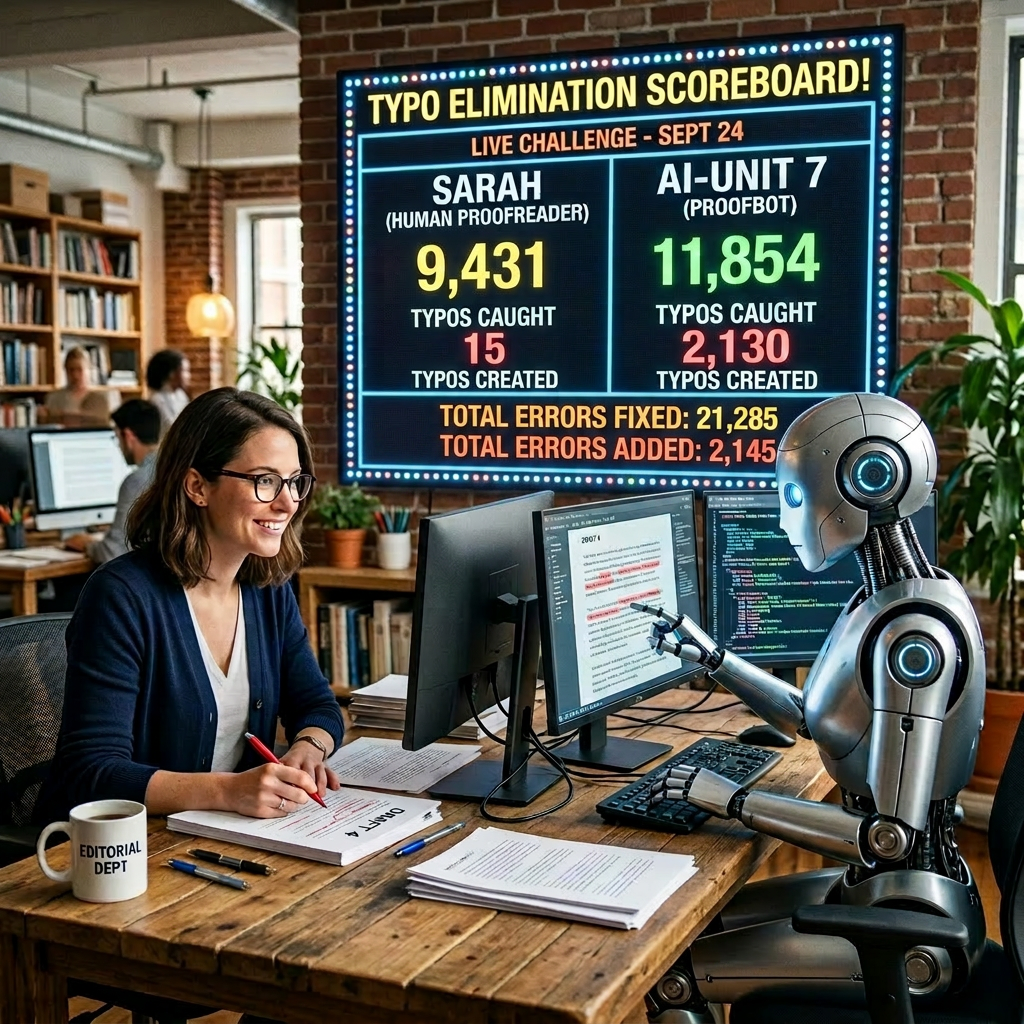
This all came to mind when, for the second time in a week or so, a very well known business book author and writer had a small typo, coincidentally in the sub-headline of their latest posts.
I caught the first one – he already had caught the second.
I see typos more now, I think, than years ago. (Maybe because I have more time to read – not ‘slam-skim’ my vast pool of emailed articles/newsletters.)
And I’m sure the ranks of media copy editors/proofreaders has thinned tremendously, as the move from “news junkies” such as myself to “news avoiders” has hurt the business in very familiar ways.
I know Grammarly, partly/mostly AI fueled, can “catch” typos before they hit the wire – I mean, web – I mean, your mailbox.
But do the makers of “content management systems” now being built/upgraded to include AI-fueled editing consider spelling-grammar/style catchers as a priority?
Yes, no and sort of. I think.
(How’s that for equivocation?;-)
But which is worse – a lil’ typo or a tool that struggles to write with human creativity? Again, that wise saying: It depends. (And a far less crucial debate than the one over AI’s hallucinations, creating “facts” that seem true but …. whoops.
Sometimes, flat, fairly predictable AI slop is obvious, but I bet we get that “can you tell?” exercise wrong – in both directions – far more often than we care to admit.
I’ve always said that I’m FAR better at catching others’ typos than my own. And I also point them out to the “offender”/sender in kind, gentle and humorous fashion, as in “Hey I live in a big glass house, no stone-throwing here!”
A helpful, not nasty tone that is usually very much appreciated by the harried, frustrated sender.
My initial reaction to a “dumb” typo – are there any smart ones? – is that small satisfaction of “aha!”
I also am happy to see that it raises the odds this really was written and edited by actual people – and hope they don’t get in trouble as a result.
But of late, I also wonder if the error came from something AI wrote. It’s a corollary of sorts to the whole “was this AI-written?” debate, which I’ve said before I consider a giant waste of time and energy. (Better to just ask: Is the writing any good?)
I believe in any business that no one should ever get in trouble for catching, even fixing a typo or grammar error. That should only happen in serious cases where someone spotted that typo/error and didn’t tell someone!
AI has the potential of making everything we write better, if we follow any of the many folks who are trying to guide our use of the tools – and if the tools get better at being what I call “super-human.” (No tights and cape involved.)
But no matter what, typos happen. And while I sure appreciated when we moved to a digital world where you can fix things instantly and “cover your tracks” – goodbye, Page 1 correction boxes! – I know it’s only a “little pebble” in the shoe we call good communication.
But get enough pebbles in your shoes, and you don’t walk too well.


Leave a Reply